Get in touch
I'm always excited to take on new projects and collaborate with innovative minds.
Phone
Website
Address
Lagos
I'm always excited to take on new projects and collaborate with innovative minds.
Lagos
While performing routine log analysis, I uncovered something most organizations completely overlook…
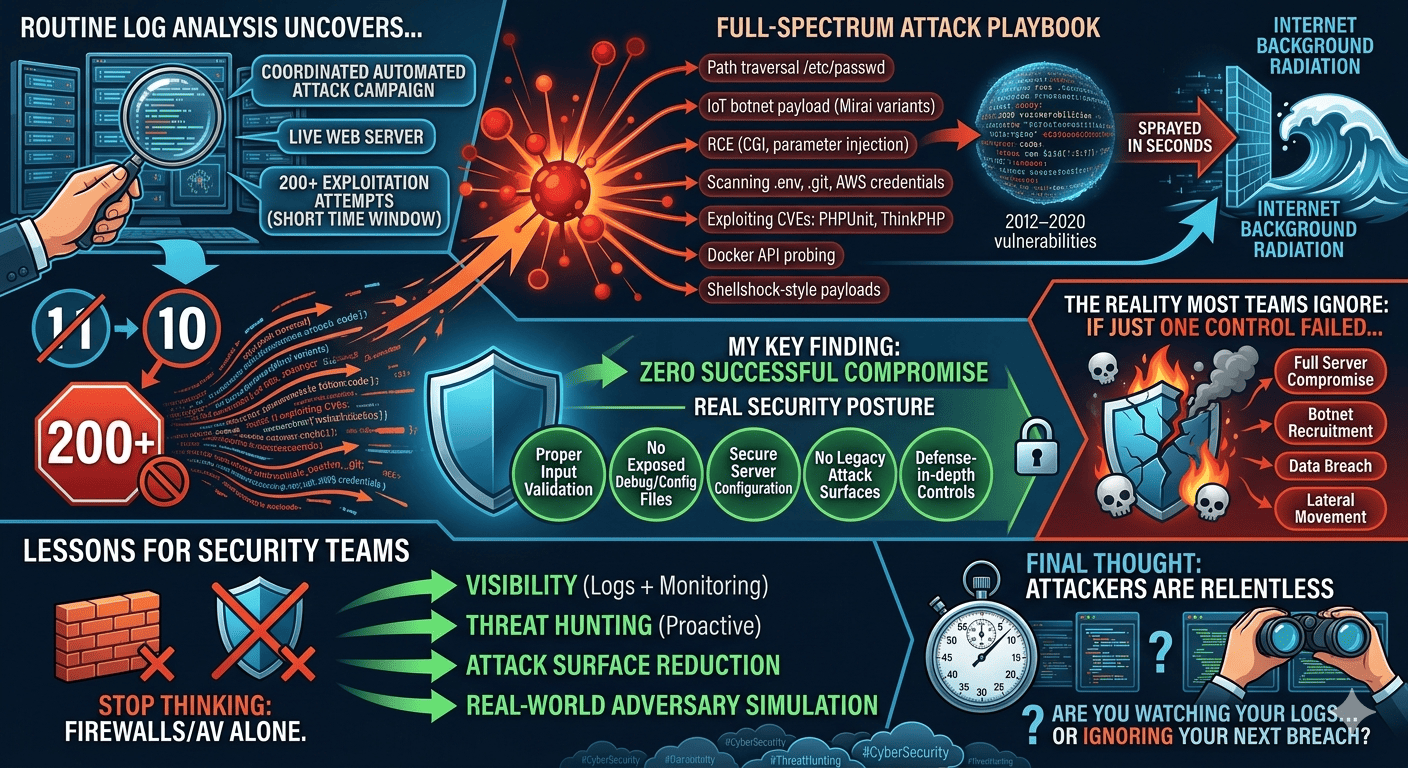
A coordinated automated attack campaign targeting a live web server.
Not 1.
Not 10.
But 200+ exploitation attempts in a short time window.
This wasn’t random noise. It was a full-spectrum attack playbook:
Path traversal attempts targeting /etc/passwd
IoT botnet payload delivery (Mirai-style variants)
Remote Code Execution (RCE) via CGI & parameter injection
Scanning for exposed .env, .git, AWS credentials
Exploiting known CVEs like PHPUnit & ThinkPHP
Docker API probing
Shellshock-style payloads
In short:
👉 Everything from 2012–2020 vulnerabilities… sprayed in seconds
This wasn’t targeted.
This is what we call:
Internet Background Radiation
Every exposed server is being constantly scanned, probed, and attacked — whether you notice it or not.
ZERO successful compromise
Why?
Because the environment had:
Proper input validation
No exposed debug/config files
Secure server configuration
No legacy attack surfaces (CGI, unused frameworks)
Defense-in-depth controls
This is what real security posture looks like.
If just ONE of those controls failed…
You’re looking at:
Full server compromise
Botnet recruitment
Data breach
Lateral movement inside infrastructure
Stop thinking security is about:
Firewalls alone
Antivirus alone
Start thinking in terms of:
Visibility (Logs + Monitoring)
Threat Hunting (Proactive, not reactive)
Attack Surface Reduction
Real-world adversary simulation
Attackers are not sleeping.
Their tools are automated.
Their scans are relentless.
The only question is:
👉 Are you watching your logs… or ignoring your next breach?
I documented the full investigation, attack breakdown, and defensive strategy.
If you're serious about Cybersecurity, Threat Hunting, or Incident Response, this is worth your time.
What’s the most dangerous attack pattern you’ve seen recently?
Your email address will not be published. Required fields are marked *