Get in touch
I'm always excited to take on new projects and collaborate with innovative minds.
Phone
Website
Address
Lagos
I'm always excited to take on new projects and collaborate with innovative minds.
Lagos
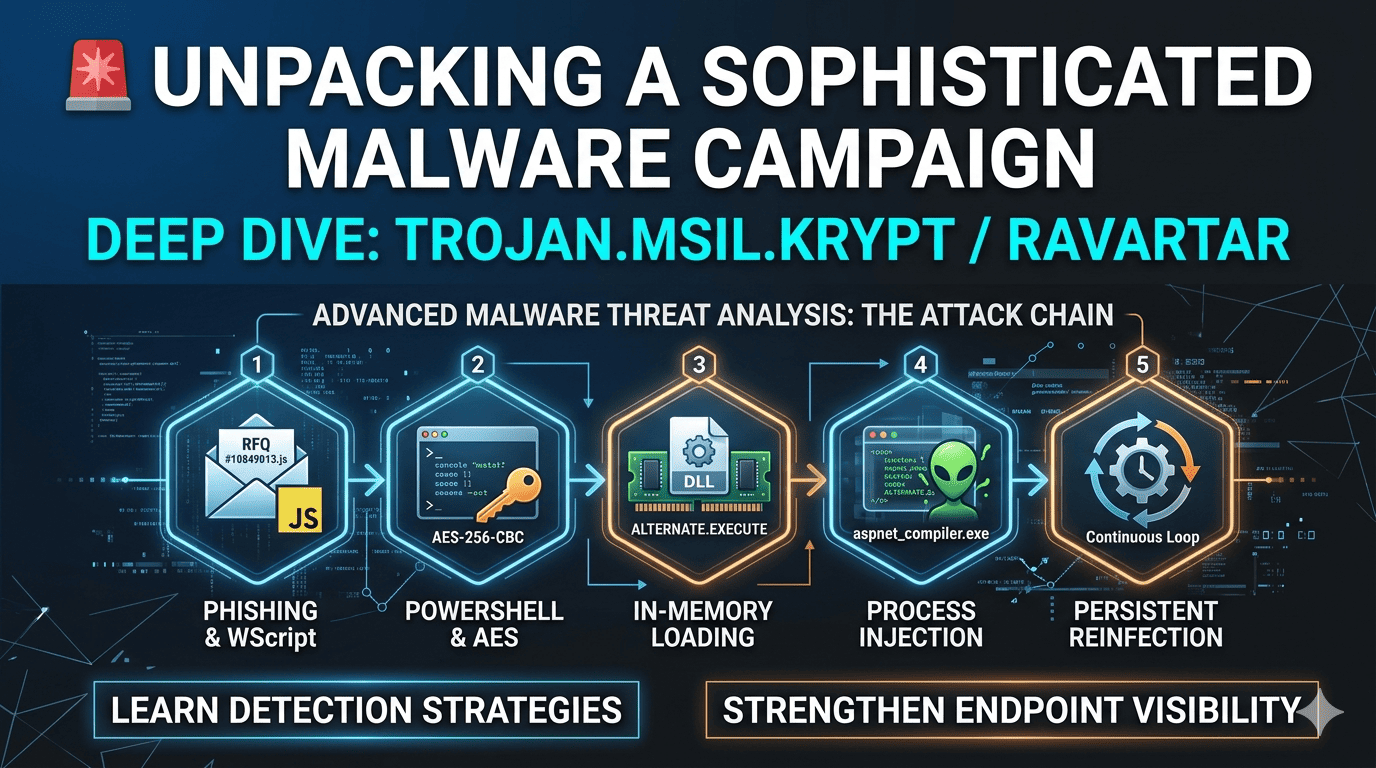
I recently completed a detailed analysis of a CRITICAL-severity multi-stage malware campaign — and the techniques used are a strong reminder of how advanced modern threats have become.
Campaign: ALTERNATE.EXECUTE (Trojan.MSIL.Krypt / Ravartar)
Detection: 44/70 AV engines
Analysis Type: Static malware analysis
This threat leverages a Living-Off-The-Land (LOTL) approach across multiple stages:
Stage 1 – Initial Access
A phishing email delivers an obfuscated JavaScript file (RFQ #10849013.js) executed via Wscript.
Stage 2 – Payload Decryption
A PowerShell script runs in stealth mode, using AES-256-CBC encryption to decrypt the next payload.
Stage 3 – In-Memory Execution
A .NET DLL (ALTERNATE.EXECUTE) is loaded directly into memory via reflection — leaving minimal disk footprint.
Stage 4 – Process Injection
The malware uses VirtualAllocEx + CreateProcessA to inject into a trusted system binary (aspnet_compiler.exe) via process hollowing.
This campaign demonstrates several high-risk behaviors:
Abuse of trusted Windows tools (WScript, PowerShell, .NET)
Multi-layer encryption (AES + XOR) to evade detection
Fileless execution via in-memory loading
Process masquerading using legitimate binaries
Continuous monitoring loop triggering reinfection
Don’t rely solely on signature-based detection — behavioral monitoring is critical
Watch for suspicious parent-child process chains (WScript → PowerShell → aspnet_compiler)
Enable PowerShell logging and enforce execution policies
Monitor abnormal usage of trusted binaries (LOLBins)
Strengthen controls around script execution and endpoint visibility
In this analysis, I developed:
✔️ Custom YARA rules for identifying all stages
✔️ Splunk hunting queries to detect execution patterns
✔️ EDR detection logic (KQL, CrowdStrike, Cortex XDR)
✔️ Clear incident response and hardening recommendations
Attackers are no longer relying on “loud” malware — they are blending into legitimate system processes and using trusted tools against us.The real challenge today isn’t just detection — it’s visibility across the entire attack chain.If you’re interested in malware analysis, threat hunting, or detection engineering, I’d love to connect and exchange insights.
Your email address will not be published. Required fields are marked *