Get in touch
I'm always excited to take on new projects and collaborate with innovative minds.
Phone
Website
Address
Lagos
I'm always excited to take on new projects and collaborate with innovative minds.
Lagos
Understanding ethical hacking is really about understanding how systems communicate, execute, and fail.
Let’s continue building that foundation.
The famous TCP three-way handshake isn’t magic.
It’s simply computers verifying communication:
SYN → SYN-ACK → ACK
Think of it as two machines confirming:
Are you there?
Can you hear me?
Good. Let’s talk.
For a real-world perspective, log into your home router.
Look at the connected devices.
That small network is your first practical security lab.
You don’t need to be a coding prodigy to succeed in security.
You need to understand logic and problem-solving.
A practical starting path:
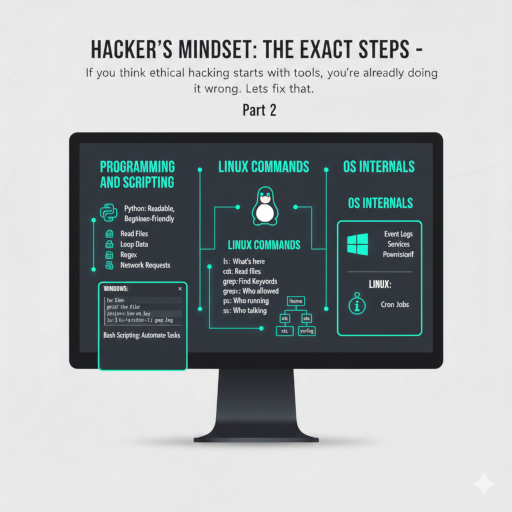
Start with Python
Why?
Readable and beginner-friendly
Widely used in security tooling
Perfect for automation and analysis
Focus on skills that matter:
Reading and writing files
Looping through data
Regular expressions
Making network requests
Then add basic Bash scripting.
Even simple command chains can eliminate hours of repetitive work.
Small scripts → Big skill development.
Most security and hacking tools thrive in Linux environments.
So you need to be comfortable there.
Install a Linux virtual machine and use it daily.
A helpful mental model:
/home → Your personal space
/etc → System control center
/var/log → System activity records
Essential commands to master:
ls → What’s here?
cd → Move around
cat → Read files
grep → Find patterns
chmod → Control permissions
ps → What’s running?
ss → Who’s communicating?
At first it feels unfamiliar.
Soon it becomes second nature.
Security professionals think beyond interfaces.
They understand how operating systems behave under the hood.
On Windows:
Event logs
Services
Basic PowerShell
On Linux:
systemd
Cron jobs
Permissions & ownership
Every platform leaves different traces.
Knowing where to look is a core security skill.
Master fundamentals.
Build intuition.
Stay curious.
Advanced techniques come later.
Your email address will not be published. Required fields are marked *