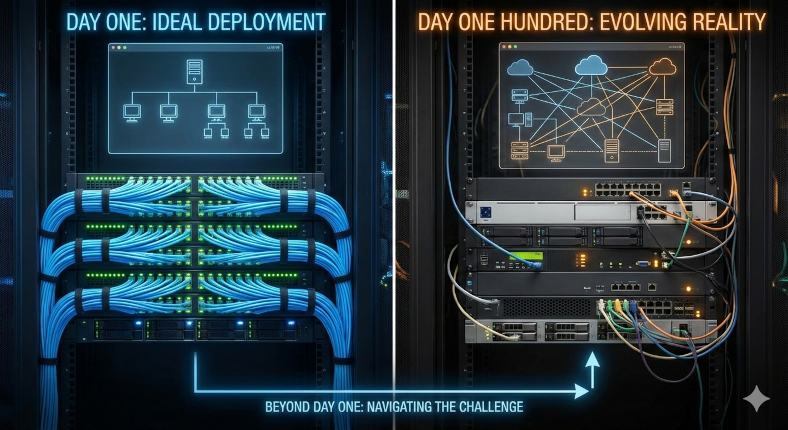
When a new network goes live, the atmosphere is often one of celebration. The design documents have been followed, the configurations meticulously applied, and the “Day One” objectives are met. Success, in this initial moment, is clearly defined. But as any seasoned professional knows, the true measure of a network isn’t found on Day One—it’s revealed on Day One Hundred, and every day thereafter.
The initial deployment is a snapshot, a system operating under expected conditions with a known set of users and devices. The future, however, is a moving picture. It’s a story of growth, change, and unforeseen demands. The pitfalls that quietly emerge are rarely about a single misconfigured protocol; they are systemic. They are the consequences of choices made under the pressure of immediate deadlines, the subtle accumulation of technical debt, and the evolving landscape of business needs.
These long-term challenges are narrative arcs: the story of a design that couldn’t scale gracefully, the plot twist of an unexpected integration, the ongoing drama of maintaining coherence as complexity multiplies. Planning solely for launch is like writing only the first chapter of a novel. The subsequent chapters—scaling, integrating, and sustaining—determine whether the story is ultimately a success or a cautionary tale.
The Network Engineers’ Perspective: The Granular Realities
While the narrative sets the stage, we, the engineers, live in the details. The challenges beyond Day One are not abstract; they are concrete, technical, and often relentless. Here’s what we see when the initial glow fades:
- The Scalability Trap: What works for 100 devices fails for 10,000. Subnetting schemes become exhausted. Routing tables bloat. Broadcast domains that were once manageable become performance killers. The core switches that were “over-provisioned” at deployment hit their capacity ceilings. Scaling isn’t just about adding more of the same; it often requires architectural redesigns—migrating from a flat L2 network to a routed spine-leaf fabric, for example—which are equivalent to heart surgery on a live patient.
- Integration Headaches: Networks are ecosystems, not islands. On Day One Hundred and beyond, you must integrate with new cloud platforms, SaaS applications, IoT sensor arrays, and systems from acquired companies. Each integration brings its own security models, protocols, and performance characteristics. Making a legacy on-premises service talk seamlessly to a modern microservices architecture in the cloud can expose fragile dependencies and create bizarre traffic flows that violate original design assumptions.
- The Maintenance Mountain: Configuration drift is inevitable. A quick fix here, a temporary ACL there, and soon no device’s running configuration matches its gold-standard template. Troubleshooting becomes forensic archaeology. Patching and upgrades, risky even in simple systems, become multi-dimensional chess games of dependency management and change windows. The operational burden grows exponentially, consuming cycles that could be spent on innovation.
- Technology Evolution & Skills Gap: The technology selected on Day One may be obsolete in three years. New protocols emerge, security threats evolve, and hardware reaches end-of-life. Meanwhile, the team’s skills must continuously evolve. The knowledge silos created during deployment (“only Alice understands the SD-WAN config”) become critical single points of failure.
- Visibility and Telemetry Decay: The monitoring that was perfect for the initial deployment often fails to keep pace. New applications create new types of traffic that your existing tools don’t recognize or measure correctly. What you can’t see, you can’t manage or secure. The gap between what the network is doing and what your management platforms think it’s doing widens silently over time.
Synthesizing the Insight: A Strategy for the Long Haul
The writers’ narrative and the engineers’ realities point to the same imperative: design for evolution, not just for operation.
- Embrace Modular, Architectural Thinking: Design with clear, loosely coupled modules (e.g., access, distribution, core, data center, cloud gateway). This allows parts of the network to scale or be upgraded independently without total upheaval.
- Automate Relentlessly from the Start: If a configuration isn’t in a code repository and deployed via automation, it doesn’t exist. Automation is the only vaccine against configuration drift and the only scalable way to manage complexity.
- Instrument Everything: Assume your telemetry needs will grow. Build in extensive logging, flow collection, and telemetry from Day One. Plan for a central observability platform that can handle unknown future data types.
- Document the Why, Not Just the What: Future engineers need to understand the design intent to know whether a change is safe. Why was this specific routing protocol chosen? What problem does this specific ACL solve?
- Institutionalize Lifecycle Management: From the beginning, have a formal plan for regular code upgrades, hardware refreshes, and security patch cycles. Treat the network as a living entity that requires scheduled care.
Conclusion
The journey “Beyond Day One” is where vision meets reality. It is a testament to the foresight embedded in the original design and the adaptability of the team that shepherds it. By blending the writers’ focus on long-term narrative with the engineers’ mastery of granular challenge, we build not just networks that work on launch day, but resilient, adaptable platforms that empower the business for Day One Hundred, One Thousand, and beyond. The most successful networks are those whose stories are still being written, whose architectures are still capable of learning, and whose teams are always looking past the horizon.